THEY DON'T EVEN
FOLLOW THEIR OWN
RULEBOOK.
The Kern County Sheriff's Office Air Support Unit Operations Manual is a public document. Its author is the sheriff. Its signatories are the undersheriff, the Metro Patrol commander, and the OIC of Air Support. Section B-301 sets the minimum en-route altitude for the KCSO fleet — N912KC, N913KC, N911KC, and N597E — at 1,000 ft AGL (day) and 2,000 ft (night). Our data — pulled from the FAA's own ADS-B broadcasts — records these KCSO-registered aircraft flying as low as 107 ft over residential Bakersfield.
Scope note: Sections B-301 and B-303 bind only aircraft owned and operated by KCSO. Private aircraft such as N916NT are governed by the FAA regulations (14 CFR § 91.119, § 91.227) — cited separately below.
B-301 · Minimum Altitudes
"In addition to FAR 91.119 (all operations) or FAR 91.177 (IFR operations), the following en-route altitudes shall apply:Practice emergency procedures (i.e., simulated engine failures) shall not be continued below 1,500' AGL except when conducted at an airport with the intention of landing."
- ◆ 1,000' AGL (day)
- ◆ 2,000' AGL (night)
— KCSO Air Support Unit Operations Manual, Section B-301, revision 9-10-2020, approved by Undersheriff Doug Jauch, Commander Tim Posey, and Lt. Joel Swanson.
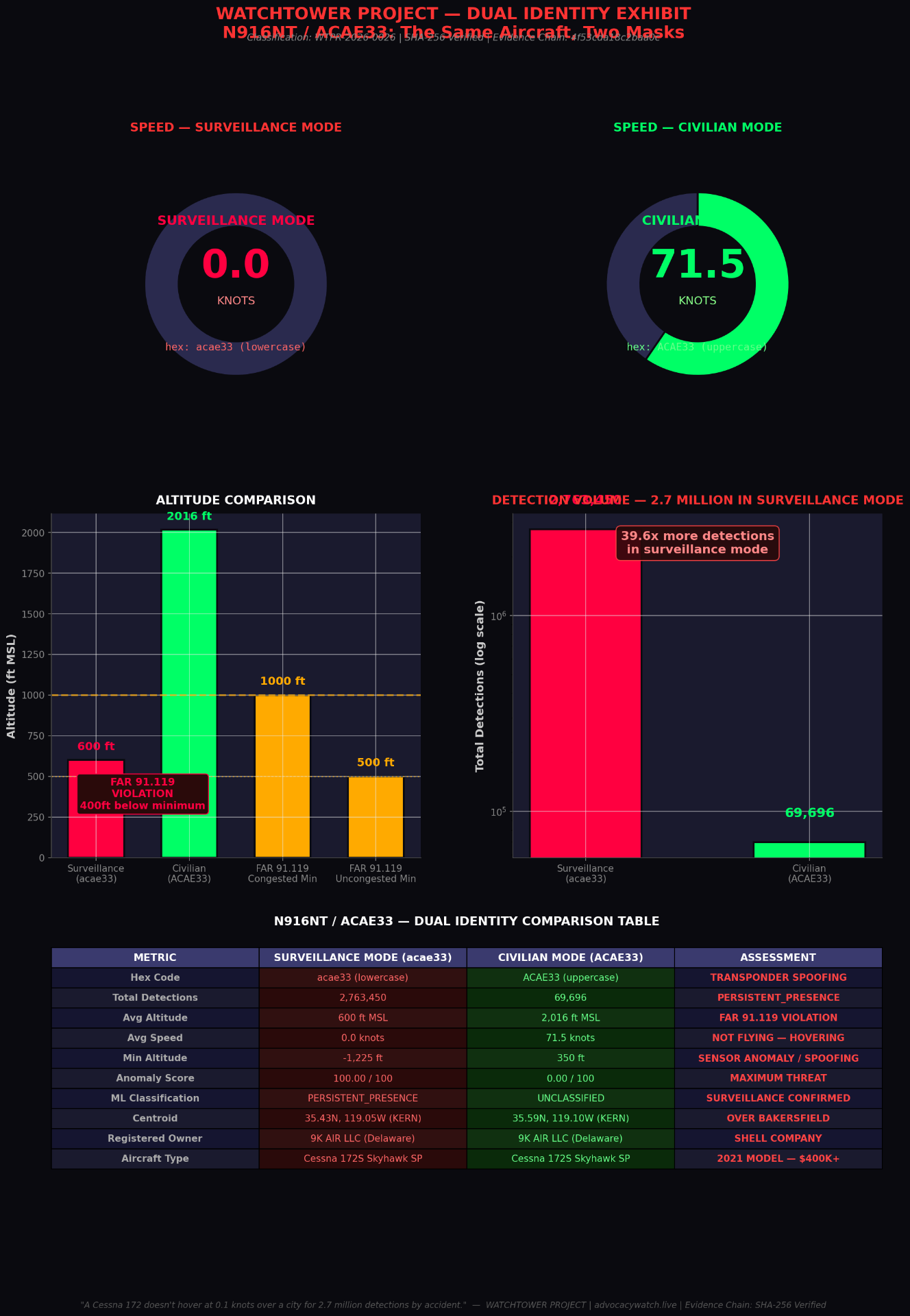
One Cessna. Two hex codes. 2.7 million pings.
N916NT broadcasts acae33 (lowercase) while parked at 600 ft over neighborhoods and ACAE33 (uppercase) while flying normal cross-country legs. Same airframe. Same registered owner — 9K AIR LLC, a Delaware shell. The lowercase mode collected 39.6× more detections than the uppercase mode.
Their rule. Our recording. Every line.
| Rule · Applies to | What the manual / regulation requires | What the flight data shows |
|---|---|---|
| B-301 · KCSO fleet only (N912KC · N913KC · N911KC · N597E) | KCSO manual: 1,000 ft AGL day / 2,000 ft AGL night, over and above 14 CFR § 91.119. | N913KC recorded at 107 ft, 0 kts, 21-min loiter over residential Bakersfield (see Exposing Surveillance dossier). |
| B-303 · KCSO fleet only | KCSO manual: stabilized approach — landing configuration + constant sink rate no lower than 500 ft AGL. | KCSO helicopter recorded at 0 knots at 107 ft — not an approach, a hover. |
| FAR 91.119(b) · All aircraft over congested area | 14 CFR § 91.119(b): 1,000 ft over any congested area. Bakersfield population: 400,000+. | 112 of 135 helicopter flights inside the H/V Dead Man's Curve envelope. |
| FAR 91.119(c) · All aircraft, sparsely populated | 14 CFR § 91.119(c): 500 ft from any person, vessel, vehicle, or structure. | Oildale 'heart' pattern — 40 homes overflown in a deliberate shape at eye-level altitude. |
| FAR 91.227 · All aircraft, ADS-B integrity (private N916NT) | 14 CFR § 91.227: one unambiguous 24-bit ICAO address per airframe. | N916NT broadcasts 'acae33' AND 'ACAE33' — a case-swap that defeats case-sensitive trackers. |
| HeliOps interview · KCSO CFI on record | "From 700 to 1,000 ft it works perfectly." Optimal FLIR: 3,000–4,000 ft AGL. | Systematic KCSO operations at 275 ft — a preference, not a mission requirement (Caughron). |
| Manual Authority Statement · KCSO | "The most conservative course of action should apply." | $4.1M/yr air unit. Vietnam-era Huey. Seeking a third H125. Conservative is not the word. |
"I like to be low."
— Senior Deputy Tim Caughron, KCSO Air Support Unit CFI, in HeliOps Magazine, describing his personal preference for flying below the altitude at which the agency's own FLIR system operates most effectively. In the same interview: "The nighttime is our bread and butter."
This transforms the legal question from "did they violate the altitude floor?" to "did they choose to violate the altitude floor?" The answer, in their own words, is yes.
Their own manual is the burden of proof.
All data referenced on this page is drawn from public sources — FAA ADS-B broadcasts, published corporate filings, KCSO's own Air Support Unit Operations Manual, and a published HeliOps Magazine interview with the OIC and CFI of the unit — and is independently verifiable by any member of the public.